Seven Generations Ahead (SGA) started as a local, grassroots effort. But climate change has no borders, and SGA was always committed to growing beyond its local roots to have the greatest impact on a global problem.
Our clean energy solutions work shows how SGA has evolved, growing from early initiatives that supported energy efficient options for local residents, to our current work consulting with municipalities and large institutions throughout the Chicago metro area and beyond to drive renewable energy projects that get real results.
Today, SGA’s approach to renewable energy development focuses on a collective impact model that takes a regional approach, pooling resources and collaborating across municipalities, public institutions, and organizations. We partner with businesses and technical experts to bring energy solutions to communities where they will have the most impact. Over 25 years, our reach has expanded to communities throughout northern Illinois and beyond to have a regional presence in the Midwest.
SGA’s Clean Energy Solutions Work In Practice
Clean Energy Close to Home
Our roots in the Oak Park-River Forest area mean we’ve been invested in local renewable energy projects for most of SGA’s history. PlanItGreen (PIG) is our collaboration with the Oak Park-River Forest Community Foundation, and it’s designed to enhance the sustainability, vibrancy, and quality of life in our communities. Through PIG, we’ve been able to provide support and expertise on numerous renewable energy initiatives that align with local climate action plans and drive measurable greenhouse gas reductions. PIG was one of SGA’s earliest initiatives focused on collaboration across institutions and communities to achieve greater impact.
“It’s a collective impact model,” said Gary Cuneen, SGA’s founder and Executive Director. “It’s really based on the goal of bringing together different institutions and leaders in the community and having them agree on common goals related to sustainability, and then working together, collaboratively, to achieve those goals.”
As the convener and hub for this collective impact model, SGA provides expertise and connections to help these institutions implement the projects necessary to reach their goals.
SGA lent support to District 200’s (D200) ambitious sustainability plan and clean energy projects for Oak Park River Forest High School (OPRF). SGA helped arrange a forum at the high school that brought together more than 20 technical experts with school administrators and other stakeholders to discuss the feasibility of solar, geothermal, and energy efficiency upgrades. When D200 subsequently chose to pursue a geothermal system, SGA was able to connect the district to geothermal technicians. The system has now been installed under OPRF’s new stadium field, and will provide 100% of the heating, cooling, and ventilation for the school’s new physical education facilities. According to OPRF, the system will save the district about $385,000 while reducing carbon dioxide emissions by the equivalent of an average passenger car driving more than 500,000 miles.
SGA also worked with Oak Park Elementary School District 97 to help develop a comprehensive sustainability policy, and encouraged a capital plan to support its implementation. The policy, much like D200’s, calls for significant greenhouse gas reductions through ambitious actions, including solar and energy efficiency projects. This work is aided by SGA’s facilitation of intergovernmental collaborations through the Cross Agency Sustainability Exchange (CASE), which helps local governing bodies work together on shared sustainability goals.
“SGA’s leadership insights, especially around greenhouse gas reductions and solar energy, will be key as we implement our new sustainability policy,” said Dr. Ushma Shah, former D97 superintendent, when the district was just getting started on implementing its new plan.
SGA has also been committed to growing support for off-site solar electricity generation by connecting local stakeholders to community solar opportunities. From the Village of River Forest and the Village of Oak Park, to River Forest Elementary School District 90, and numerous other institutions, SGA has demystified community solar and made it easy for municipalities, institutions, and local residents to meet clean energy goals, even if onsite solar isn’t an option.
One of SGA’s longstanding local partners in renewable energy development is the Park District of Oak Park (PDOP). Sustainability and the commitment to greenhouse gas reduction is a cornerstone of PDOP’s philosophy, and park district facilities across the village reflect that commitment. The Park District was an early member of PIG, and have not only been able to share knowledge, but have benefitted from connecting and learning from others, as well. Jan Arnold, Executive Director of PDOP, says there’s great value in the peer-to-peer sharing and connections with experts that SGA provides through the PIG initiative.
“By having the opportunity to talk to others that have done different types of projects, we can ask ourselves: ‘how do we fit into that model?’” Arnold said.
SGA has supported PDOP in many of its renewable energy projects. In SGA’s newly launched PlanItGreen Podcast, Arnold cites SGA’s help in connecting to Green Mountain Clean Energy and the Illinois Clean Energy Community Foundation as two examples of ways that SGA and PIG have supported the development of clean energy at park district facilities.
These local collaborations through PIG demonstrate what’s possible, and how SGA has helped clean energy solutions scale beyond the local.
Growing Beyond Our Borders: Collective Impact
With 25 years of work in climate and sustainability, SGA has grown well beyond our local roots in the Oak Park-River Forest area. For our energy work to have impact at scale, we knew we had to reach communities across Cook County and beyond. But SGA wasn’t just focused on growth. To achieve real results and measurable emissions reductions, we’ve prioritized collaboration and collective action.
The Cross Community Climate Collaborative, or C4, is SGA’s model for bridging scale and coordination to maximize our impact. C4 is an award winning collaboration that brings together underserved and resourced communities to drive climate, equity, and sustainability outcomes. C4 was founded and is led by Village of Broadview Mayor Katrina Thompson, Village of Oak Park President Vicki Scaman, and Village of River Forest President Cathy Adduci, along with Darnell Johnson of the Urban Efficiency Group and SGA Executive Director, Gary Cuneen.
“It’s amazing to work with two other female leaders, Cathy Adduci and Katrina Thompson, to bring a regional approach on sustainability, working with, now 15 communities, and increasing that number, for greater impact,” said Scaman. “We see communities that are working together that have never worked together before.”
So what does a commitment to equity and collective impact mean on the ground?
It means SGA working with five solar companies to provide reduced-rate solar electricity to low-to-moderate income residents across C4 communities. This is saving participating residents up to 50% off the electricity supply cost, while supporting grid-scale solar projects in Illinois and reducing greenhouse gas emissions.
Funding for clean energy solutions is a barrier that SGA has worked to break down. Across the C4 region, we’ve connected institutions and municipalities to federal and state funding opportunities to install electric vehicle charging stations. But we haven’t stopped at cars. SGA is also working to help institutions and school districts secure electric buses. We’re focused on maximizing the impact of the growth of EV infrastructure, making EVs a more accessible and practical option, which in turn helps provide relief from volatile fuel prices for institutions and residents.
As more institutions around the C4 region are looking to pursue on-site solar, SGA has lent our expertise to explore funding options for these capital-intensive projects, as well. Whether it’s Brookfield Zoo, Dominican University, or the Forest Preserves of Cook County, SGA has helped large public and private energy consumers assess on-site solar capacity and financial options to meet their emissions reductions goals. We walk these institutions through ownership options, but we’ve also developed partnerships with private companies to help institutions access private capital to fund their on-site solar projects. And we bring in our expertise in securing federal and state funding to also help offset costs. Over years of working in this field, we’ve learned that navigating these technical and financial questions becomes a significant barrier for large institutions and municipalities to follow through on clean energy projects, so SGA has stepped in to provide that roadmap.
Another way we provide that roadmap is through municipal-scale energy plans. Through C4, in partnership with the Urban Efficiency Group, SGA has developed an energy plan for the Village of Broadview to help it reach clean energy goals and drive greenhouse gas reductions. The community-wide energy plan tailors the solutions to Broadview’s specific needs, while helping the village remain focused on affordability, effectiveness, and implementation.
“A lot of times in underserved communities and disadvantaged communities, environmental sustainability is not a top of the line initiative because we deal with so many other issues,” said Mayor Thompson. C4 helps address those inequities so projects like the Broadview Energy Plan have the support and resources needed to move forward and benefit the community.
“From my lens I see it as partnerships and collaboration, but educating on a broader level where those more influential communities can learn to partner with underserved communities to share the resources,” she said. “And that’s why this work is so important, because when we’re talking about it, we’re not leaving out anybody, especially when we’re talking about humanity and what’s best for people. It impacts all of us.”
From SGA’s earliest clean energy solutions work that encouraged residents to make energy efficient choices, to today’s work that prioritizes scale and impact at both municipal and regional levels, our evolution reflects our years of expertise and a deeper, more sophisticated understanding of what it takes to build more sustainable communities.
As we continue to grow our energy work across the Chicago region and beyond, this essential role as consultant and convener has become the core of what we do. SGA helps communities plan large-scale energy transitions at both the municipal and institutional levels, guiding stakeholders through complex technical and financial questions, all while focusing on bringing the most innovative, effective, and affordable solutions that are replicable and scalable. It’s this grounded, practical approach, coupled with a commitment to collaboration and equity, that exemplifies how we achieve collective impact.
A Closer Look: Chicago Public Schools Go Solar
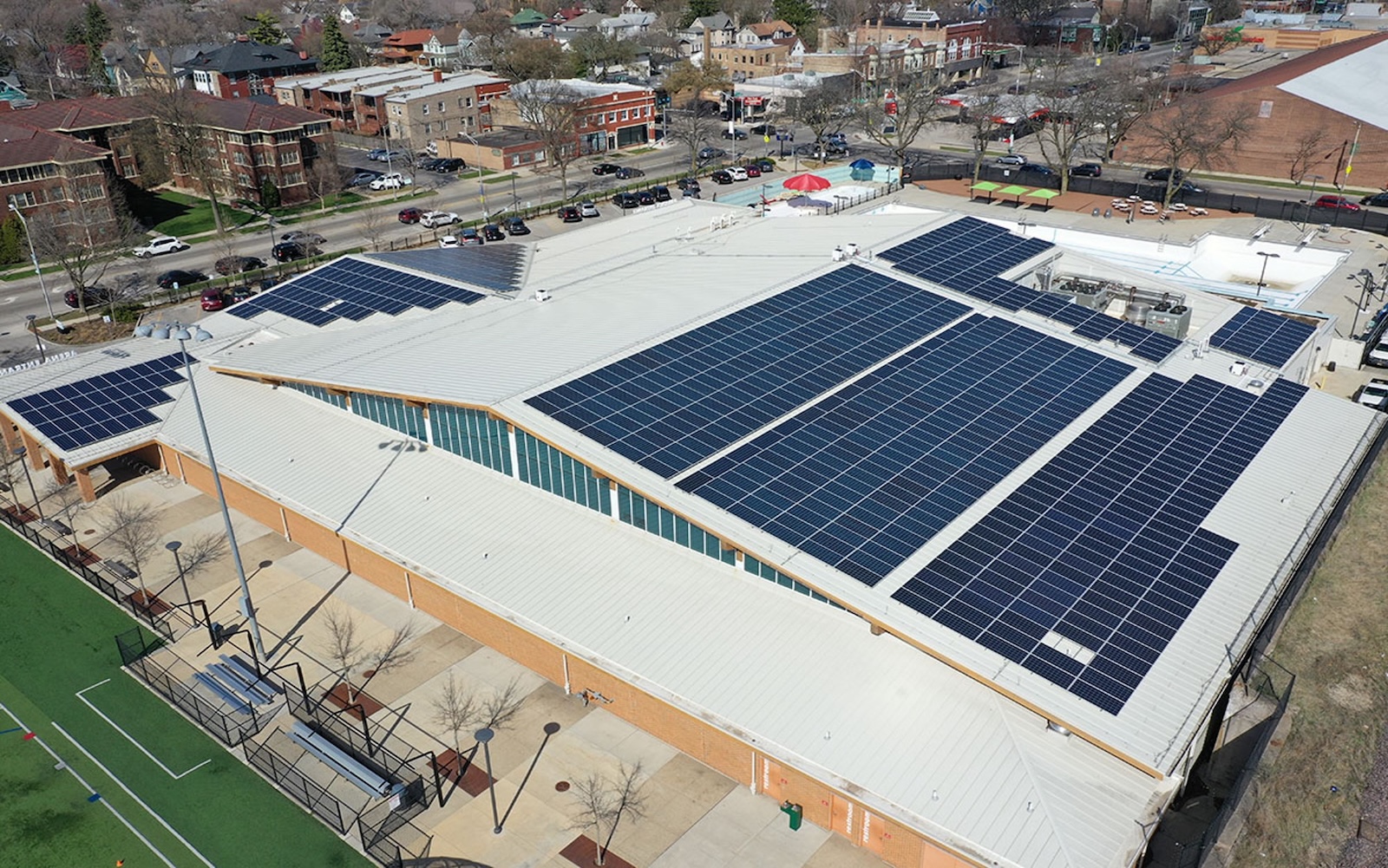
SGA has worked closely with Chicago Public Schools (CPS) for years to help the school system achieve their sustainability goals. Our collaboration on CPS Goes Solar highlights the value SGA can bring to large institutions seeking clean energy solutions. This initiative had several key goals:
- Maximize on-site solar on CPS buildings;
- Procure renewable energy from newly developed solar projects in Illinois toward meeting its goal of 100% renewable energy procurement
- Develop an energy road map that supports CPS in its greenhouse gas emissions reduction goal of reducing emissions by 45% by 2030 from 2010 levels; and
- Educate students on solar technology, the climate crisis and connect them to solar industry professionals
Our work on this initiative started by conducting a solar array capacity analysis on 550 CPS buildings. This gave us a baseline by which to understand how many buildings were good candidates for on-site solar arrays. Next, SGA worked with CPS to develop criteria for the viability of solar projects. And finally, we supported CPS in creating their RFP for the identified solar projects. As CPS continues to work toward its clean energy goals, SGA’s expertise and guidance supports the school system’s progress in this complex work. This is an example of how SGA’s energy solutions work can grow across large institutions, cities, and beyond, with a commitment to large-scale impact always at the heart of what we do.
Looking to the Future
The federal funding landscape for renewable energy may be volatile and uncertain, but the momentum and support behind clean energy solutions is undeniable. As SGA looks to the future of our work in clean energy, we see continued growth. For example, the Inflation Reduction Act tax incentives for battery storage still remain, and SGA is partnering with Inbalance2030 and Convergence Energy to drive more battery storage and solar projects across the Chicago region. We’re expanding our work connecting K-12 schools, municipalities, and waste haulers with vehicle fleets to a turnkey EV bus and vehicle retrofit program, bridging clean energy and transportation to achieve greater impact.
And while the federal government may be fickle in its support for renewable energy, state and local governments are stepping in to fill the gaps. The Illinois Shines program is one such example of a bright future for clean energy. SGA will continue providing education and consulting for K-12 schools on the Illinois Shines program, which provides incentives for the development of both on-site and community solar projects. Similarly, SGA is continually growing the number of communities and institutions we work with throughout the state, supporting the development of comprehensive and actionable energy plans. And as we look ahead to the years to come, we’re excited to host more GreenTown Conferences, which bring together municipal leaders, businesses, nonprofits, and sustainability advocates to discuss, catalyze, and collaborate on energy and sustainability solutions. The future of SGA’s energy solutions work will undoubtedly bring even more collective impact throughout Illinois and beyond.