By Ashley Gonzales
On Monday, February 2, 2026, Seven Generations Ahead (SGA) hosted the “State of Food Policy” webinar highlighting the Illinois Feed and Conserve Movement and Senate Bill 2852 (SB2852). The webinar brought together state leaders, advocates, researchers, and industry partners to share coordinated, statewide solutions that deliver environmental, economic, and community benefits. The message was clear: SB2852 represents a win for people, the economy, and the environment in Illinois.
The webinar opened with an overview of Seven Generations Ahead (SGA), a 25-year-old nonprofit organization advancing community-driven climate, equity, and sustainability solutions. SGA has long worked to expand practical, scalable approaches to food waste reduction and organics diversion across Illinois. While food scrap composting and surplus food recovery programs have grown in recent years, these efforts have often been piecemeal and uneven. Without strong, coordinated state policy, their environmental and economic impact remains limited. SB2852 aims to provide the statewide framework needed to align policy, infrastructure, and education.
SGA is also a founding member of the Illinois Food Scrap & Composting Coalition (IFSCC), a statewide partnership of nonprofits, local governments, composters, businesses, and advocates working to reduce food waste and expand organics diversion. The coalition emerged from stakeholder conversations in 2012, including discussions at SGA’s GreenTown conference. Since then, Illinois has expanded from just two pilot residential food scrap collection programs to more than 100 programs statewide, providing access to over 900,000 residents. However, many communities still lack infrastructure and awareness. With growing food insecurity, climate impacts, and landfill pressures, Illinois has reached a turning point that calls for comprehensive policy action.
Illinois State Senator Adriane Johnson, sponsor of SB2852, emphasized the bill’s triple-win framework. For people, the legislation increases food donation and ensures high-quality edible food feeds neighbors rather than filling landfills. For the economy, it supports job creation and strengthens local markets. For the environment, it reduces methane emissions by diverting food waste from landfills. The bill combines education, infrastructure investment, and clear standards to support long-term success.
Emily Wachter of SWALCO provided an overview of the bill’s development and amendments. Legislative discussions began in 2025 under SB1398/HB1707, which gained bipartisan co-sponsors and strong grassroots momentum. The Feed and Conserve Illinois movement mobilized more than 470 individual supporters and 50 organizations, generating over 500 witness slips in committee support. Following stakeholder meetings throughout summer and fall 2025, amendments were incorporated into SB2852 for the 2026 legislative session.
The legislation applies to “Covered Establishments,” defined as commercial or institutional generators of food and food waste such as restaurants, grocery stores, hotels, and airports. The bill also includes provisions to protect food recovery organizations and requires state agencies and local governments to purchase compost or digestate, helping to build stronger end markets for organic materials.
Stephanie Katsaros of Bright Beat presented findings from the Food Recovery Infrastructure Assessment (FRIA). The assessment revealed that large volumes of surplus edible food are not currently being rescued. While tax incentives exist, awareness varies widely, and liability concerns persist despite federal protections. The research underscored that food recovery requires coordination, infrastructure, and capacity, not just surplus.
Dr. Howard Rosing, Executive Director of the Steans Center at DePaul University, shared statewide mapping research on grocery stores and food donation partnerships. Of 274 grocery stores analyzed, fewer than half had established food donation partnerships or were actively engaged in food rescue. The data, available through DePaul University’s Illinois Food Waste and Recovery Data Collection System, highlights significant untapped recovery potential.
Darby Hoover of the Natural Resources Defense Council (NRDC) presented economic modeling conducted with IFC using IMPLAN analysis. Drawing from EPA Food Excess Opportunities Data, Illinois EPA waste characterization data, stakeholder surveys, and literature review, the analysis evaluated two policy scenarios. Under SB2852, Illinois could support approximately 8,200 jobs, generate $2.2 billion in industry output, and create $100 million in tax revenue through supply chain and economic ripple effects. The bill could divert an estimated 1.4 million tons of food waste from landfills annually and reduce emissions by 7 million metric tons of CO₂ equivalent over ten years.
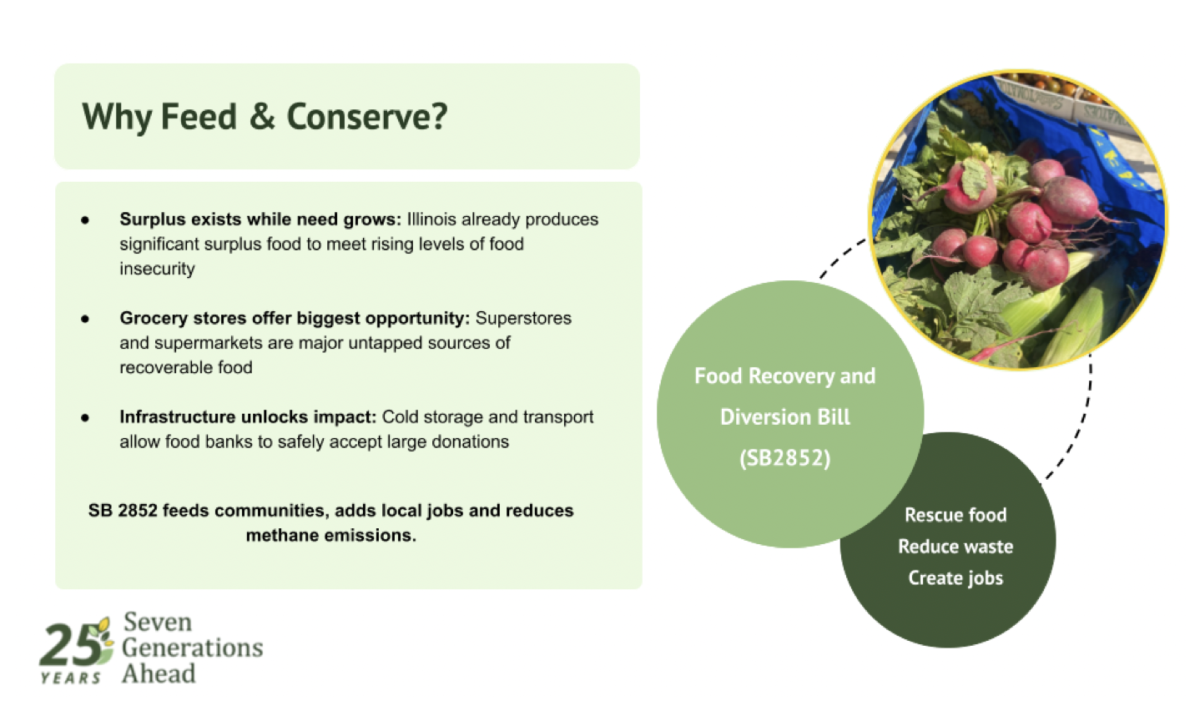
The webinar concluded with a clear call to action. SB2852 feeds communities, creates local jobs, and reduces methane emissions. Illinois already produces sufficient surplus food to help meet rising food insecurity. Superstores and supermarkets represent major untapped opportunities for food recovery, and investments in cold storage and transportation infrastructure will allow food banks to safely accept larger donations.
Attendees were encouraged to support the Feed and Conserve Illinois movement by signing up for updates, submitting witness slips when the bill is heard in committee, contacting legislators to encourage sponsorship, and sharing information through their networks. Through coordinated policy, infrastructure investment, and education, Illinois can strengthen its food system by preventing waste, rescuing surplus food, and recycling organic materials, building a more resilient and sustainable future for the state. Missed this event? See the recording here.